
Limewash gives brick a soft, matte, slightly cloudy look that weathers and fades over the years. Paint gives you a solid, uniform color in the sheen you choose. Which one is right depends on three things: the look you want, whether your brick is bare or already painted, and how much upkeep you are happy to take on. At Alan’s House Painting we handle both masonry painting and limewashing in the Davis and Sacramento area, so the choice can follow your brick and your taste, not what one crew happens to offer.
TL;DR
- Look: limewash is chalky, translucent and varies from wall to wall. Paint is opaque, even and comes in many colors and sheens.
- Aging: limewash is meant to weather and can be refreshed by simply adding a coat. Paint holds a crisp, consistent finish and is renewed with a repaint.
- Starting point matters most: limewash needs bare, porous brick. If your brick is already painted, paint is usually the practical route.
- Cost: both are priced by square footage, prep and number of coats. A site visit gives you a real number, not a national average.
- Next step: a free estimate and a color consultation settle the question on your actual wall.
Table of Contents
- What limewash and paint each do to brick
- How they look on your house
- Check your brick before you choose
- Moisture: why breathability comes up so often
- Durability and upkeep
- What each costs
- Which one fits you
- How we approach a brick project
- FAQ
- Sources
What limewash and paint each do to brick
The two products work in different ways, and that explains almost every difference you will see.
Paint forms a film on the surface. The Brick Industry Association (BIA), the trade body for clay brick manufacturers, describes acrylic latex paint as an opaque finish available in a wide range of sheens. It softens the natural texture of the brick, and over time it needs to be reapplied.
Limewash is a mineral coating made from lime. The same BIA publication explains that it gets its durability from a process called carbonation: as the coating cures, it forms calcite crystals that bond chemically with the masonry. Instead of sitting on top like a skin, it becomes part of the surface.
That difference shows up in four places.
| Limewash | Paint | |
|---|---|---|
| Finish | Matte, chalky, translucent | Opaque, even, many sheens |
| Color range | Natural pigments, usually softer and more limited | Nearly unlimited |
| Consistency | Varies by wall, brick and number of coats | Uniform |
| Aging | Weathers into streaks and fades gradually | Holds its look until it is repainted |
How they look on your house
Limewash: soft, mottled, a little old-world
According to the BIA, limewash has a naturally nonuniform matte finish, and how opaque it looks depends on how much water is in the mix and how many coats go on. The Spruce adds that it starts out semi-transparent and becomes more opaque with additional coats. Darker bricks show through, so a multicolored brick wall ends up with a variegated, almost tonal look.
That suits a house with character: a 1920s bungalow in East Sacramento or Curtis Park, a brick fireplace wall, a garden wall, a cottage-style facade. It is not the right choice if you want a crisp, flat, identical color from corner to corner.
Paint: clean lines and a decision you control
Paint is the answer when color precision matters. You can choose a deep charcoal, a bright white, a warm cream, or an accent shade that ties the brick to the trim and door, and you will get that color evenly across the wall. Sheen is also yours to pick, from flat to satin and beyond.
For business owners and property managers this matters more than it sounds. A storefront, an office or a multi-unit building often has a brand color or a consistent look across several walls. Uniform coverage is easier to specify and easier to repeat later.
A quick way to decide
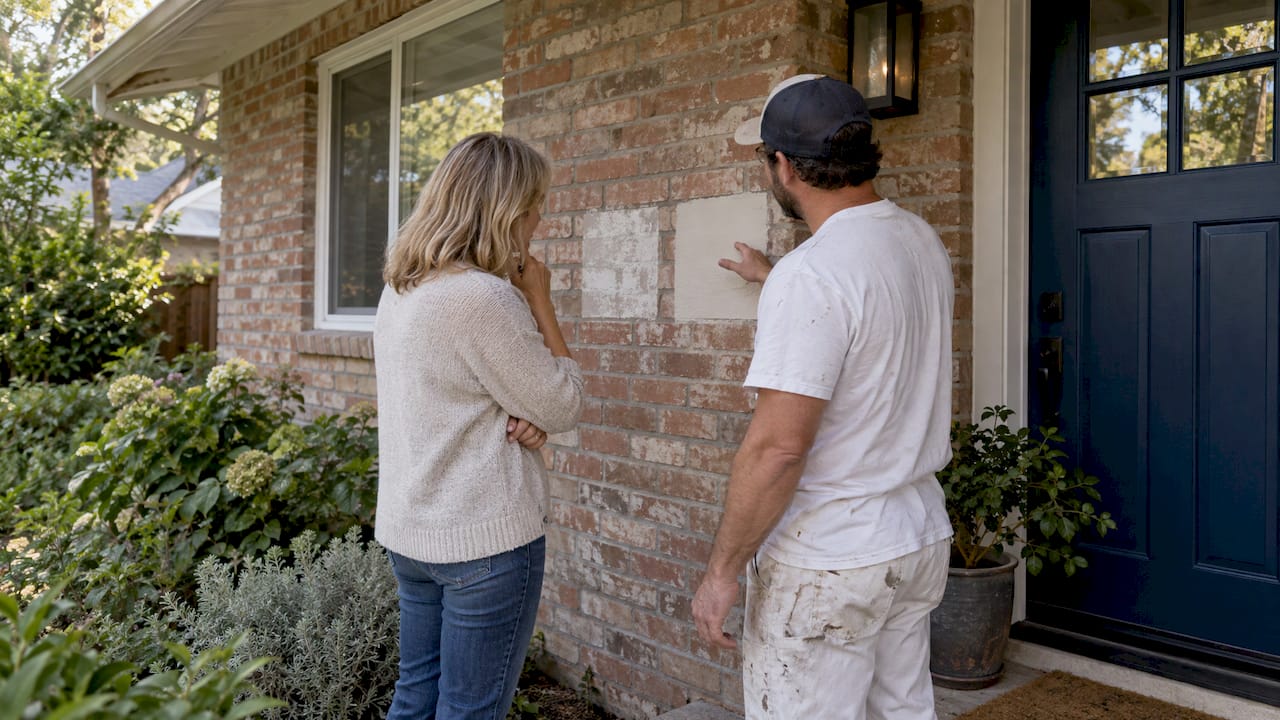
Stand across the street from your house and ask one question: do I want the brick to look like brick, only calmer, or do I want a new color? If it is the first, limewash fits. If it is the second, paint fits. Our color consulting is built for exactly this question, and seeing sample colors on your own wall in your own light beats any photo online. Light in Davis is strong and direct in summer, and it changes how pale shades read. Our post on choosing colors by light, purpose and brand walks through that.
Check your brick before you choose
This is where most of the decision is really made. Two questions come first.
Is the brick bare or already painted?
Limewash grips by soaking into porous, unpainted masonry. It does not bond well over an existing layer of acrylic or latex paint, so on a wall that has been painted before it is likely to fail early, and the only way to prepare it for limewash is to remove the old paint first, which is a large job in itself. If your brick was painted by a previous owner, painting again is normally the more straightforward path, and a well-prepared repaint gives a clean result.
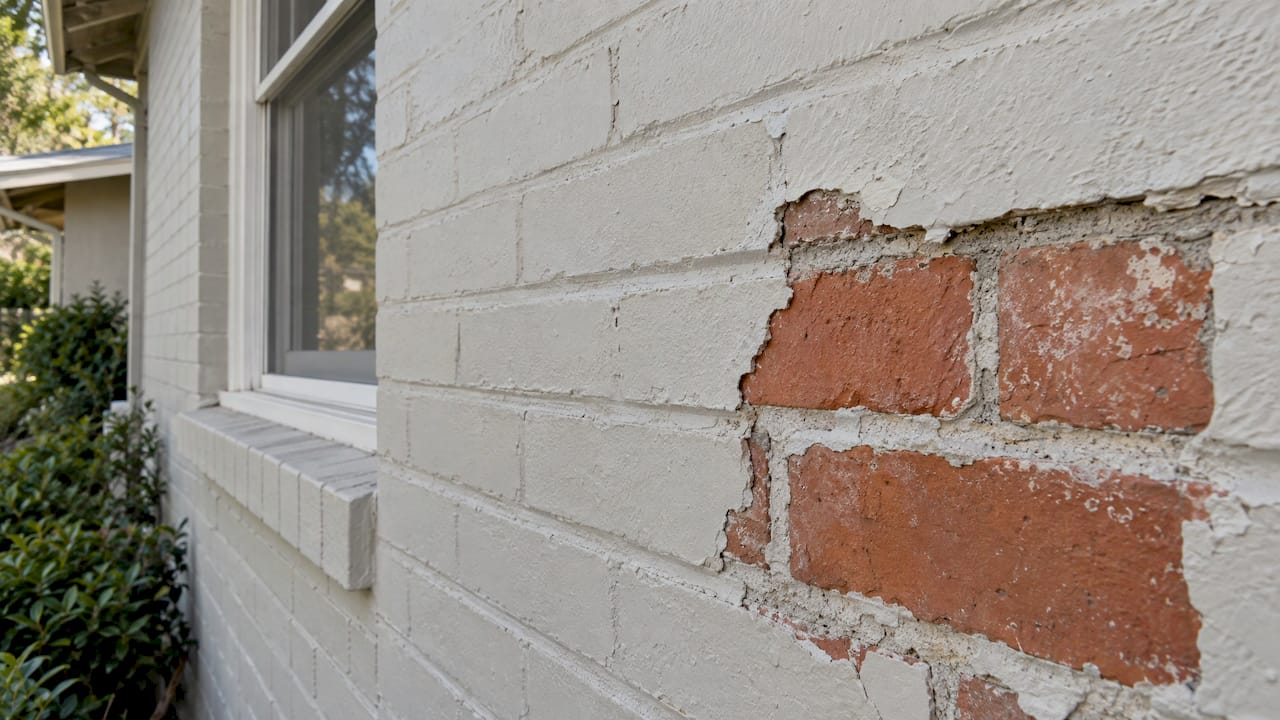
If you are not sure what is on your brick, tell us when we visit. A painted coat is usually easy to spot in mortar joints and along edges, where the film breaks.
Is the brick porous, and is it sound?
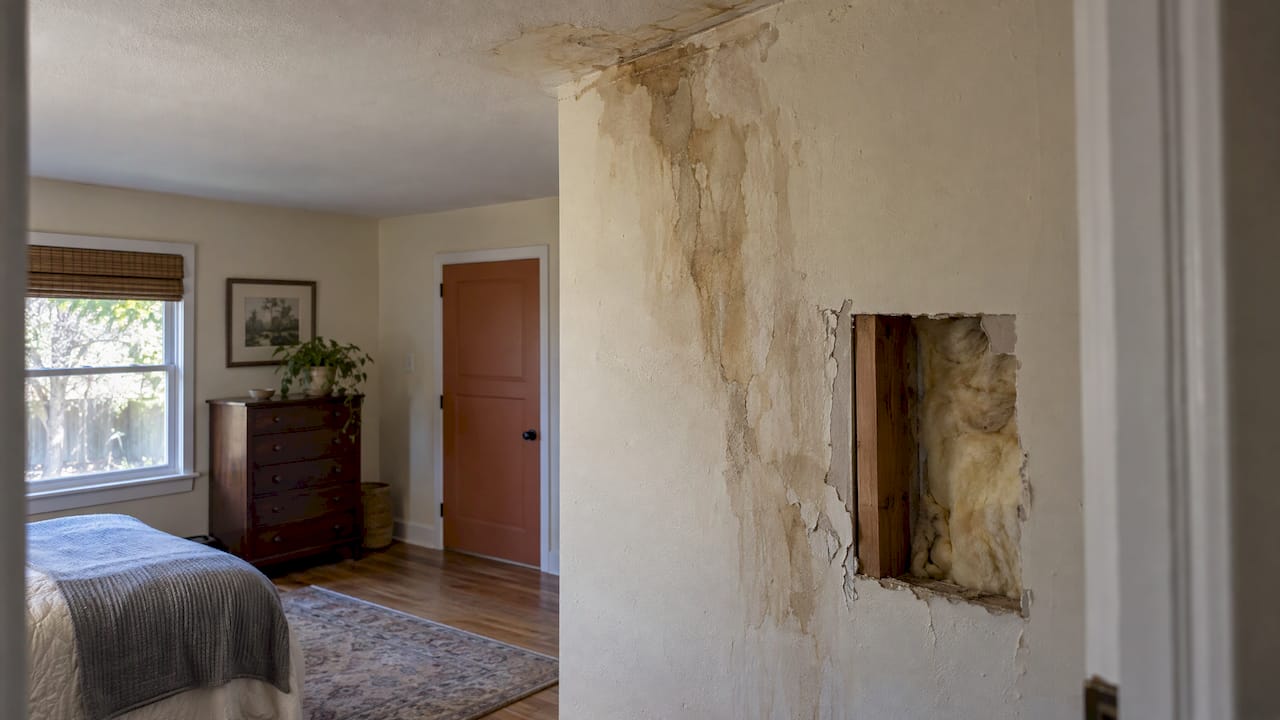
Very dense, hard-fired or glazed brick may not absorb limewash well. Before committing a whole wall, a small test patch in an inconspicuous spot shows how the brick takes it. We also look at the condition of the wall itself: crumbling mortar, flaking brick faces, white powdery salt deposits (efflorescence), and any sign that water is getting in. Those get dealt with before any coating goes on, whichever one you choose. That kind of preparation is the part of a job that decides how long it lasts, as we explain in Before the First Coat.
Older homes deserve extra care here. Pre-war brick, soft historic brick and walls with repointed mortar all behave differently from a modern brick veneer, and the choice of coating should respect that.
Moisture: why breathability comes up so often
Brick is porous. It takes on moisture and releases it again as the weather changes. A coating affects how easily that exchange happens.
Limewash keeps the pores open. The Spruce notes that this breathability is a reason limewash is often recommended for brick homes in places with harsh winters or large temperature swings, because trapped moisture is one reason coatings on brick peel. The BIA makes a related point: it does not recommend sealing limewash where the permeability of the wall should not be reduced.
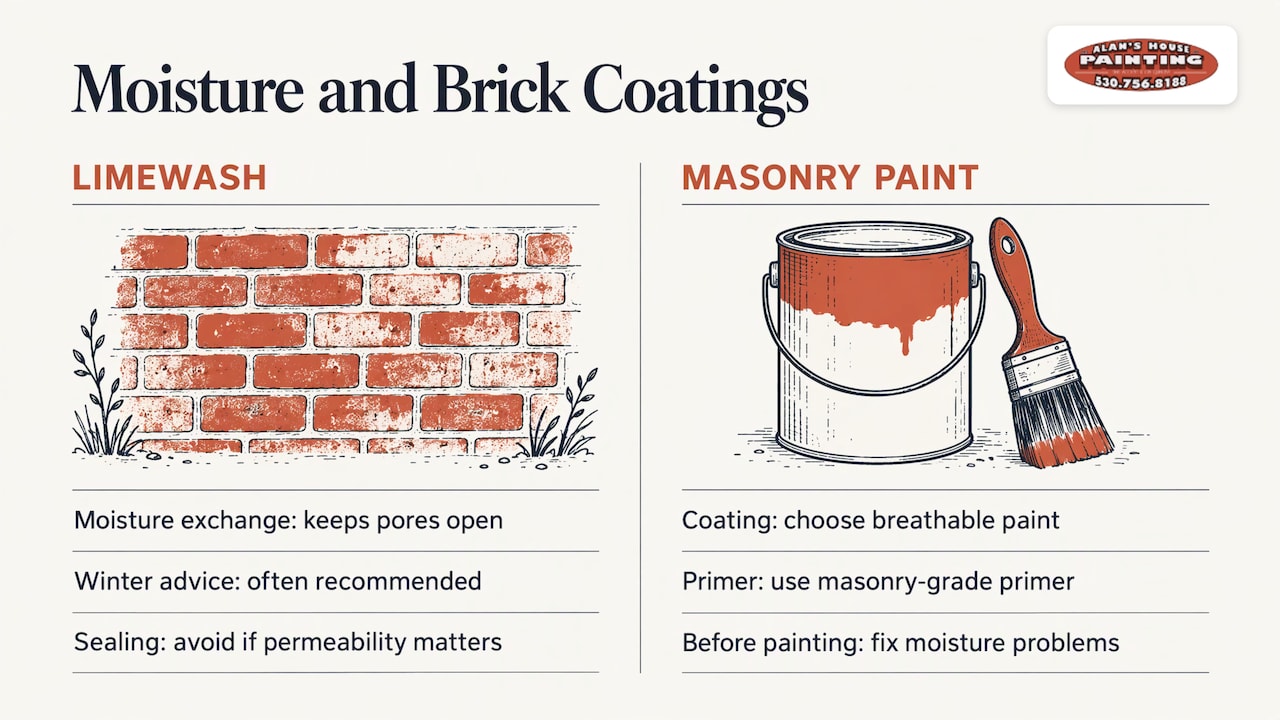
The practical takeaway for paint is to use the right system for masonry. A masonry-grade primer and a breathable masonry paint, applied over a dry, sound wall, are what a good exterior brick job calls for, and moisture problems found during the inspection are fixed first. Our region has mild, dry summers and wet winters rather than deep freezes, but rain, irrigation spray and a north-facing wall that never dries out all count. Exterior paint for all seasons covers how weather shapes product choice.
Durability and upkeep
How long limewash lasts
The BIA says limewash can last five to ten years or more, depending on the environment, the number of coats and how much weathering you want. Refreshing it is simple: new coats go over old ones without stripping anything back. Limewash is not meant to look the same on day one and in year eight. It ages in a way that many owners like.
A few honest care points for you to plan around. The Spruce notes that limewashed surfaces can scuff and are not washable, and the BIA says interior limewashed surfaces are not typically washable either, because moisture removes limewash over time. That makes limewash a better match for walls people do not lean on, rub against or scrub: a street-facing facade, a chimney, an accent wall. For a busy mudroom wall or a kids’ play area, a paint with a washable sheen is the easier match.
How long paint lasts
Paint is the choice for owners who want a finish that stays consistent. A properly prepared and applied exterior coat holds its color evenly, and repainting returns the wall to its original look. Wall condition, sun exposure and the quality of the prep all affect timing, and our guides on signs it is time to repaint your exterior and how to know when your exterior needs repainting help you spot when that is.
For commercial buildings the rhythm is the same, with the addition of scheduling: planned maintenance keeps a storefront or office looking cared for, and regular paint maintenance is easier to budget than a rushed repaint.
What each costs
Both finishes are priced by the same things: how many square feet of brick you have, how much repair and preparation the wall needs, how many coats it takes, and how hard the wall is to reach. A one-story ranch with a simple facade and a two-story house with a tall gable are very different jobs.
A few things that tend to move the number:
- Prep. Cleaning, repairing mortar, treating efflorescence and masking take real time, and they are where careful work shows.
- Coats. Limewash builds opacity coat by coat, so a bolder look can mean more passes. Paint needs a primer and finish coats.
- Height and access. Second stories, steep grades and landscaping that has to be protected add labor.
- Existing paint. Brick that is already painted rules out limewash unless the old coating is removed first, which adds a significant cost of its own.
For reference, our published ranges for the Davis and Sacramento area are $2,500 to $8,000 for interior painting and $3,500 to $12,000 for exterior painting, depending on the size and scope of the project. Masonry painting is quoted per project, because the wall decides the work. Quotes on national price sites vary widely, so we would rather measure your house than hand you an average.
If you are weighing resale, the look matters as much as the cost. A clean, well-chosen exterior color is one of the most visible things a buyer sees, and we cover that in adding value and curb appeal through exterior painting.
Which one fits you
Choose limewash if:
- your brick is bare and unpainted;
- you like a soft, aged, slightly irregular look;
- you are happy with a gentler palette;
- you like the idea of refreshing it with another coat every several years.
Choose paint if:
- your brick is already painted;
- you want a precise color and an even look;
- you want to match trim, doors and other surfaces closely;
- the wall is one that gets touched, splashed or cleaned;
- you manage a commercial property that needs a consistent brand color.
Not sure? That is common, and it is a good reason to walk the property with someone before deciding. A short sample on the wall and a look at the mortar tells you more than a comparison chart.
Interior brick is a separate question
Fireplaces and feature walls follow the same logic, with one extra point: interior limewash is not washable, as the BIA notes, so it suits a fireplace surround better than a kitchen backsplash. A painted fireplace can be wiped down and gives you a wider color range, so the best choice depends on how that wall lives. Our interior painting team can walk through the options with you.
How we approach a brick project
We have been painting homes and businesses since 1975, and masonry painting and limewashing are part of what we offer, alongside color consulting. On a brick job, we start with careful preparation and attention to detail, and we specify the paint products so you know what is going on your walls. Each project runs through a personal concierge who gives you daily progress updates, and we offer guarantee and warranty options. Our crews work respectfully in your space, whether that is a home in Land Park, a bungalow in Midtown, a property in El Macero or a commercial building in Woodland.
If you are choosing between limewash and paint, the simplest next step is a free estimate. We will look at the brick, tell you what we see, and show you color options. You can start on our exterior painting page or find color consulting and cabinet refinishing on our services page.

For commercial properties, the same process applies, and you can reach us through the Alan’s House Painting home page to request an estimate for a storefront, office or multi-unit building.
FAQ
Does limewash last longer than paint on brick?
The BIA puts limewash at five to ten years or more, depending on environment, coats and the weathering you want. Paint’s lifespan depends on prep, exposure and the product used. The better comparison is how each ages: limewash fades gradually and is refreshed with another coat, while paint stays uniform until it is repainted.
Can you limewash brick that has already been painted?
Limewash needs bare, porous brick to bond. Over existing acrylic or latex paint it is likely to peel, and removing the old paint first is a major added job. For previously painted brick, a properly prepared repaint is normally the more practical option.
Is limewash cheaper than paint?
Not always. Both are priced by square footage, preparation, coats and access. Limewash can need several coats to build opacity, and paint needs primer and finish coats. A site visit gives you an accurate figure for your own brick.
Is limewash washable?
No. The Spruce lists scuffing and lack of washability among its limits, and the BIA says interior limewashed surfaces are not typically washable. It suits facades, chimneys and accent walls better than high-touch surfaces, where a washable paint sheen is the easier match.
Does painting brick affect resale value?
It depends on the home, the color and the condition of the brick. A clean, well-prepared exterior in a color that suits the architecture makes a strong first impression. Because choices differ by house, we look at the property before recommending a direction.
Sources
- Changing the Appearance of Brick Masonry, Brick Industry Association
- Limewashed Brick: Everything You Need to Know, The Spruce